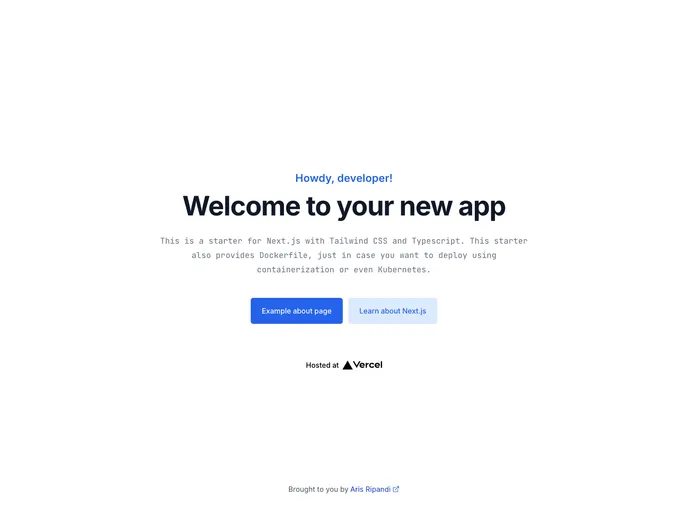
Next Start screenshot

Next Start

Author Avatar Theme by Riipandi
Updated: 20 Nov 2025
52 Stars

This is a bare-bones Next.js template, powered by Tailwind CSS v4, TypeScript, and OpenNext (optional).

Categories

Overview

This is a starter project for Next.js with Tailwind CSS and Typescript. It comes pre-configured with absolute import, TailwindUI, Framer Motion, and other additional features. It also provides a Dockerfile for deployment using containerization or Kubernetes. The article provides instructions on installation and running the application, as well as deployment options using Vercel, Cloudflare, and GitHub.

Features

  • Next.js with Tailwind CSS and Typescript
  • Pre-configured with absolute import, TailwindUI, and Framer Motion
  • Dockerfile included for containerization or Kubernetes deployment
  • Hot reload for development
  • Build for production
  • Launch generated build
  • Integration with Vercel for deployment
  • Configuration for monorepo with app/web root directory
  • Integration with Cloudflare for deployment
  • Support and thanks to open-source contributors
  • Open-source software licensed under the MIT license

Installation

  1. Change “myapp-name” with your actual application name.
  2. Install dependencies using one of the following commands:
    • NPM: npm install
    • Yarn: yarn
    • PNPM: pnpm install
  3. Start the development server with hot reload using one of the following commands:
    • NPM: npm run dev
    • Yarn: yarn dev
    • PNPM: pnpm dev
  4. Build for production using one of the following commands:
    • NPM: npm run build
    • Yarn: yarn build
    • PNPM: pnpm build
  5. Launch the generated build using one of the following commands:
    • NPM: npm run start
    • Yarn: yarn start
    • PNPM: pnpm start
  6. The application will run at http://localhost:3000.

Summary

This is a starter project that provides a foundation for developing Next.js applications with Tailwind CSS and Typescript. It includes pre-configured features and tools such as absolute import, TailwindUI, and Framer Motion. The project also offers options for deployment using Docker, Vercel, Cloudflare, and GitHub. It is open-source and licensed under the MIT license. Users are encouraged to support the open-source community and contribute to the project.